There are no items in your cart
Add More
Add More
| Item Details | Price | ||
|---|---|---|---|
Balancing board exams and engineering preparation is exhausting, leaving many science students anxious about securing a strong backup plan. You are already putting in hours of intense hard work, but the sheer competition makes relying on a single path incredibly risky. This guide explains JEE Mains 2026 Syllabus clearly and shows what to evaluate next.
The good news is that the rigorous math foundation you are building right now gives you a massive advantage for top management entrance exams. If you are already tackling the JEE Mains 2026 syllabus, you possess the exact quantitative skills needed to dominate the IPMAT.
You can leverage your existing math strengths while strategically bridging the gap in verbal ability and logical reasoning. By pivoting your current preparation slightly, you can secure a highly lucrative seat at IIM Indore without dropping your core engineering focus.
The Integrated Program in Management Aptitude Test (IPMAT) is a direct ticket to a five-year dual degree at prestigious institutes like IIM Indore and IIM Rohtak right after Class 12. Instead of grinding through four years of engineering just to write the CAT later, this path combines your undergraduate and MBA studies into one seamless journey. For science students feeling overwhelmed by the sheer volume of the JEE Mains 2026 syllabus, this exam offers a highly rewarding alternative. Establishing a strong home base for your preparation early gives you a massive head start.
Science students naturally hold a massive advantage in the Quantitative Ability section. Because you already spend hours solving complex algebra and higher math problems, the arithmetic questions feel much more approachable. Think of it like training with heavy weights; when you finally pick up a lighter dumbbell, the movement feels effortless. Your existing math foundation means your IPMAT preparation can focus less on learning basic formulas and more on mastering speed and accuracy.
Choosing an Integrated MBA over a traditional engineering route completely changes your career trajectory. While many graduates struggle with placements or pay heavy tuition for a separate master's degree, an IIM tag guarantees premium corporate roles. When you compare the long-term earning potential against standard college expenses, the financial math heavily favors the management route. You step into leadership positions faster, bypassing crowded entry-level jobs.
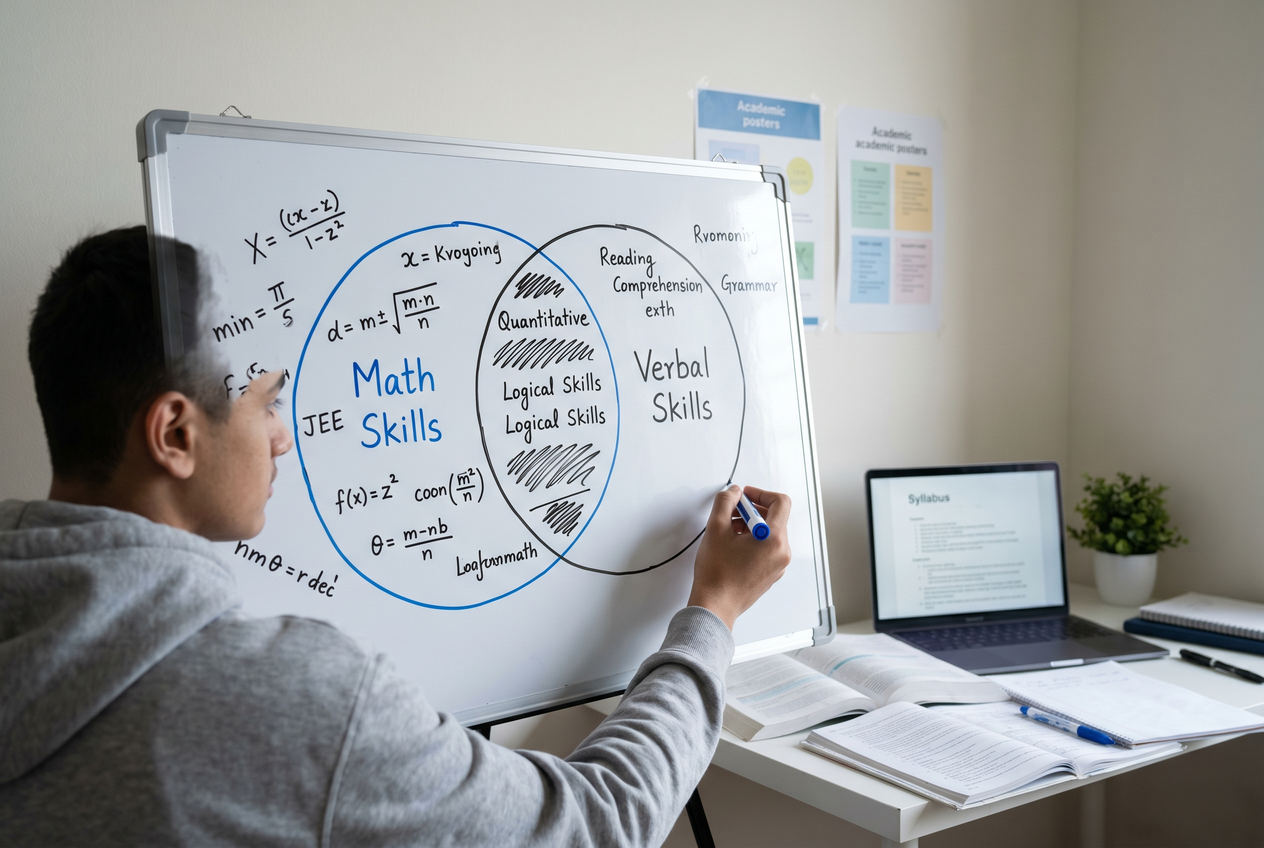
Looking at the JEE Mains 2026 syllabus reveals a massive advantage for science students. Your rigorous math preparation already covers the heavy lifting for the IPMAT Quantitative Ability section. Topics like advanced algebra, geometry, and number systems are areas where you already have a solid foundation. Instead of learning these from scratch, you just need to shift from solving lengthy engineering problems to finding quick, logic-based shortcuts.
However, relying solely on math will not guarantee an IIM seat. The biggest missing pieces in your current routine are Verbal Ability (VA), Reading Comprehension (RC), and Logical Reasoning (LRDI). Engineering preparation ignores these areas, meaning you must actively build your vocabulary and reading speed. This is where structured coaching becomes essential, helping you bridge the gap between solving equations and analyzing reading passages efficiently.
The way you are tested also changes dramatically. While engineering exams rely on standard multiple-choice questions, IPMAT introduces a unique Short Answer (SA) section where you must type the exact numerical answer without options. You cannot rely on elimination strategies here, making accuracy critical. Taking an IPMAT mock test early is the best way to experience this format and adjust your pacing.
Consider these key trade-offs when shifting your focus:
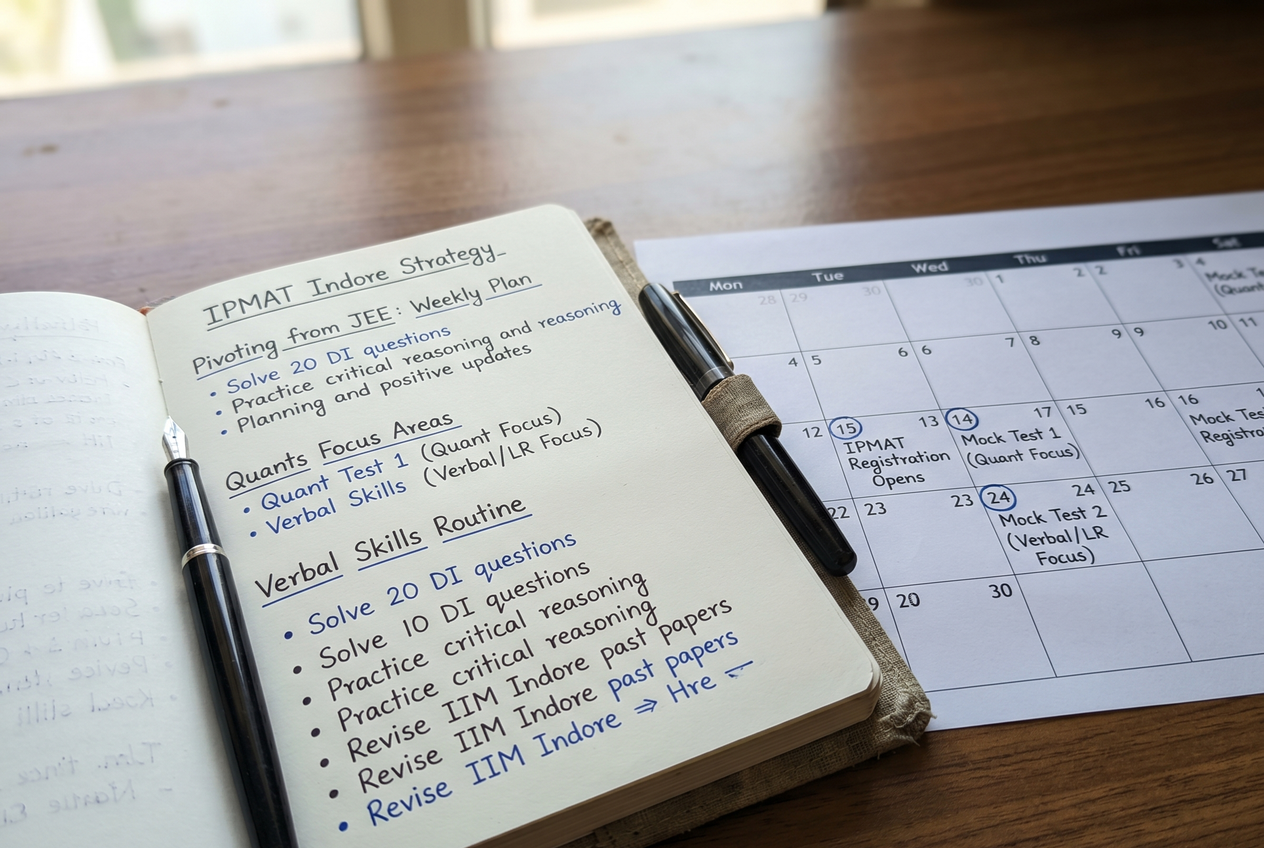
Balancing your engineering prep with management entrance exams requires a smart timeline for 2026. Since your math foundation is strong, dedicate your early months to mastering the IPMAT exam pattern. Spend your weekends focusing purely on the specific arithmetic and algebra topics that differ from your board syllabus. Once you build that baseline, you can shift focus toward the sections that usually challenge science students.
Tackling the verbal section does not have to feel overwhelming if you break it down into daily habits. Instead of memorizing thick grammar books, read editorial articles for thirty minutes a day to naturally improve your vocabulary. Think of reading comprehension like solving a physics problem; you are simply looking for the main variables, which are the author's tone and the central argument.
True confidence comes from applying these concepts under strict time limits. After setting your foundation, transition from learning theory to solving IPMAT previous year questions to understand how examiners set traps. Platforms like Rodha focus heavily on concept clarity before pushing you into rigorous mock test application, helping you spot weak areas quickly.
Science students often fall into the trap of relying entirely on their math skills while ignoring Verbal Ability. Because you spend hours solving complex physics problems, it feels natural to stay in that comfort zone. However, meeting the IPMAT eligibility criteria requires passing strict sectional cutoffs across all subjects. If you ace the math section but fail the reading comprehension cutoff, your overall score will not secure an interview call.
Another major mistake is treating Short Answer questions exactly like engineering numericals. In engineering exams, you often have time to write out long derivations. Management aptitude tests, however, demand rapid mental math and quick elimination techniques. To fix this, your study plan must include taking exam-specific mock tests rather than just solving random worksheets. Proper mocks help you adapt to strict time limits and teach you which questions to skip.
Failing to balance your board exams, engineering entrance dates, and management test timelines in 2026 will quickly lead to burnout. You cannot study for everything simultaneously without a structured schedule. Finding the right coaching helps organize this chaos by providing a clear roadmap that bridges your existing math knowledge with new verbal concepts. To keep your preparation on track, actively avoid these specific habits:
Transitioning from physics to reading comprehension requires a shift in how you process information. Science students often struggle with Verbal Ability because it feels subjective compared to the exact answers in mathematics. Rodha solves this by breaking down grammar rules and reading strategies into logical frameworks that feel just like solving an equation. Having a mentor explain these concepts simply makes a massive difference. Instead of memorizing endless vocabulary lists, you learn to identify passage tones and eliminate wrong options systematically.
Relying on generic textbooks often leaves students confused about what to prioritize for their IIM Indore preparation. A structured online course provides a clear roadmap, ensuring you spend your limited time on high-weightage topics. Think of it like having a GPS for your study plan. Instead of guessing which logical reasoning puzzles matter most, you get a curated path that builds your skills progressively. This mentor-led approach keeps you accountable and ensures your preparation stays balanced across all sections.
Taking the next step requires moving from passive reading to active practice. Rodha offers a serious, outcome-driven platform designed specifically for students targeting top management programs in 2026. You can explore our comprehensive curriculum and mock test series directly to see how our methodology aligns with your goals.
Transitioning from engineering exams to management entrances might feel like a massive leap, but science students actually hold a hidden advantage. When you compare JEE vs. IPMAT, you will notice that the rigorous math practice you do for physics naturally prepares you for the quantitative sections of management exams. Your brain is already wired to solve complex equations quickly. However, relying on math alone will not secure your seat at a top business school. You need a balanced preparation strategy that bridges the gap between numbers and language.
Navigating the 2026 syllabus requires a clear focus on where you are strong and where you need help. Because your quantitative foundation is solid, your next step is finding the right preparation strategy to master reading comprehension. Whether you are aiming for Indore or focusing on IIM Rohtak, a structured approach makes the pivot much easier. Here is exactly what matters most when shifting your focus from engineering to management:
Readers evaluating this topic also tend to search for:
The overlap is substantial in the Quantitative Ability section. The rigorous algebra, arithmetic, and higher math concepts you study for engineering provide a massive advantage. However, IPMAT requires you to pivot your focus toward speed-based problem solving and entirely new sections like Verbal Ability.
Absolutely. Many science students treat IPMAT as a strategic backup. Because your math foundation is already strong, you only need to dedicate a few hours a week to mastering Verbal Ability and Logical Reasoning. Rodha provides targeted modules designed specifically to bridge this gap efficiently.
Science students often struggle with reading comprehension and grammar. The most effective approach is consistent, daily reading combined with structured conceptual learning. Rodha's Verbal Ability modules break down complex grammatical rules and comprehension strategies into logical, easy-to-digest frameworks that appeal to an analytical mindset.
Yes, IPMAT Indore is unique among management entrance exams because its Quantitative Ability section frequently tests higher mathematics. Your background in calculus, matrices, and trigonometry gives you a distinct edge over non-math students, making it an ideal alternative path to an IIM.
Prioritize your primary goal but integrate management mocks strategically. Take one IPMAT mock test every two weeks to build stamina for the Verbal and LRDI sections. As the exam approaches, analyze these mocks to identify specific weak points. Rodha offers comprehensive mock analysis to streamline this process.
While IPMAT Indore does not have a dedicated LRDI section like the CAT, logical reasoning concepts are often woven into the Quantitative Ability questions. Developing strong analytical reasoning skills is crucial. Rodha's curriculum ensures you are prepared for these hybrid questions without wasting time on irrelevant topics.
The GDPI round is critical. While your math skills clear the written cutoff, the interview tests your communication and business aptitude. Science students must actively work on articulating their pivot from engineering to management. Rodha provides dedicated mentorship to refine these exact interview skills.

GDPI Prep 1
A California-based travel writer, lover of food, oceans, and nature.